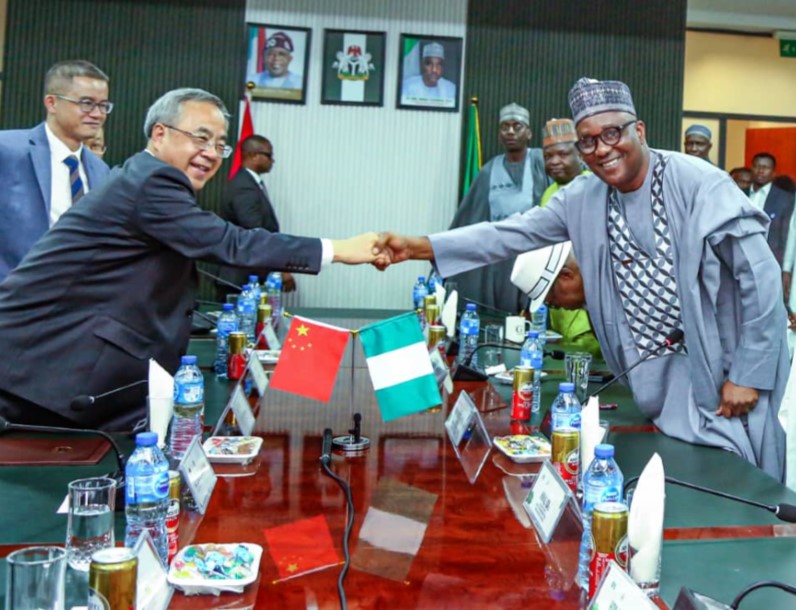
Leaders of the two chambers of the Nigeria’s Federal Legislature have called for stronger ties with the People’s Republic of China. The Senate President, Godswill Akpabio and the Speaker of the House of Representative, Dr. Abbas Tajudeen spoke at separate meetings with the Chinese Parliamentary delegation led by the Vice-Chairman of China’s top advisory body, Chinese People’s Political Consultative Conference (CPPCC), Mr. Hu Chunchua.
The Senate President advocated deepening of Parliamentary collaboration between the two countries. Akpabio made the call while hosting Chinese delegation led by the Vice Chairman of the National Committee of the 14th Chinese People’s Political Consultative Conference(CPPCC), Hu Chunchua paid him a courtesy visit in his office at the National Assembly.
CPPCC is a top political advisory body in China and a central part of the country’s multi-party consultative and inclusive democratic process. Receiving his guests, Akpabio said Nigeria is particularly impressed by the role of the Chinese People’s Political Consultative Conference (CPPCC), and its contributions to policy-making through democratic consultation.
The Senate President described CPPCC as a model of inclusivity and strategic consensus-building and. welcomed closer ties and greater exchanges between the Nigerian Parliament and the CPPCC, for mutual learning and institutional cooperation. Akpabio said Nigeria is eager to deepen cooperation with China, to learn from its experience and adapt its principles to “our own national development goals.”
The Senate President also recalled President Bola Ahmed Tinubu’s State Visit to China where he, together with the Chinese leader, Xi Jinping, envisioned a Comprehensive Strategic Partnership between Nigeria and China. “That decision was not merely a political gesture. It was, and remains, a declaration of shared destiny,” he said.
Akpabio assured the Chinese delegation that the 10th National Assembly stood ready to play its full role in advancing the implementation of all bilateral agreements, deepening parliamentary diplomacy and ensuring that the legislative framework for the Nigeria-China relations remained robust, fruitful and forward-looking.
“Your Excellency, in summary, Nigeria is ready. Ready for the next chapter. Ready to turn blueprints into skylines. Ready to turn MoUs into monuments. Ready to dream not in isolation, but in partnership—with China at our side. “May this visit mark not an end, but a beginning—not a celebration of what we have done, but a call to action for what we must still achieve,” Akpabio said.
Akpabio also informed the vistors that the outcomes of the Forum on China-Africa Cooperation (FOCAC) and the Belt and Road Initiative were bearing fruit in Nigeria. He said: “We are witnessing real impact, not just in infrastructure, but in trade, technology, healthcare, education, and human development. We hope to continue expanding our engagements across new frontiers, especially in digital innovation, green economy, capacity building and cultural exchange. We are also aware of some challenges—especially around trade imbalances and visa reciprocity—and we believe that through honest dialogue, mutual understanding, and continued diplomatic engagement, we can overcome these hurdles and strengthen the foundations of our cooperation.”
Earlier, the leader of the delegation, Hu Chunchua described Nigeria as a major country in Africa with considerable influence stressing that China always attach great importance to its relationship with Nigeria. Chunchua said “my visit is to enhance communication and cooperation between the CPPCC and relevant institutions in Nigeria to better implement the important consensus reached by our two Presidents and the outcome of the Beijing Summit to deepen the China-Nigeria Comprehensive and Strategic Partnership.”
While addressing the delegation during a visit to his office, the speaker of the House of the House of Representatives, Abbas Tajudeen cited the Belt and Road Initiative and the Forum on China-Africa Cooperation as practical platforms that the two countries have mutually engaged with the result of tangible outcomes.
According to him, “In the face of evolving global trade dynamics, exemplified by the recent imposition of tariffs by the United States that have affected our non-oil exports, it is imperative that we diversify our trade partnerships. Enhancing our economic ties with China presents significant opportunities for our nation.
“In this regard, Nigeria is equally enthusiastic about deepening cooperation through platforms such as the Belt and Road Initiative and the Forum on China-Africa Cooperation. These initiatives provide promising avenues for expanding trade, fostering investment, and promoting knowledge exchange.”
He further observed that as the world witnesses China’s remarkable economic transformation, “we find in its experience a model of inspiration, particularly in the areas of industrial policy, poverty reduction and technological innovation.”
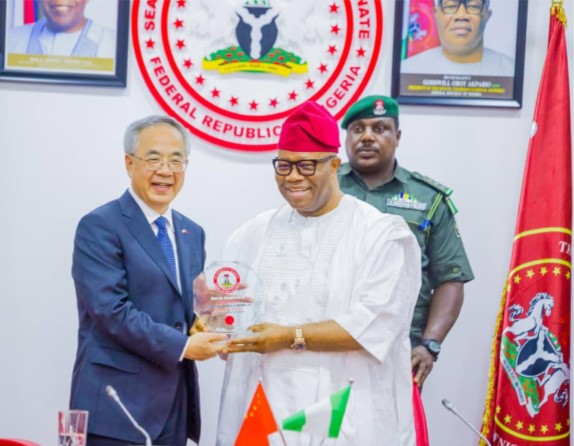
The Speaker stated that the National Assembly is dedicated to building enduring institutional ties with key Chinese legislative bodies, including the China People’s Political Consultative Conference and the National People’s Congress. He said this collaboration will enable mutual learning on legislative reforms, effective constituency representation, and democratic innovation and added that the results of China’s recent ‘Two Sessions’, with their focus on inclusive development, scientific advancement, and environmental sustainability, present substantial common ground for both nations.
Speaker Abbas further stressed that the enduring and strategic partnership between Nigeria and the People’s Republic of China lies at the core of the countries’ international relations. He noted that their collaboration spans vital sectors such as infrastructure, trade, health, and education.
“The recent elevation of our relationship to a Comprehensive Strategic Partnership is clear evidence of the mutual trust and resolve cultivated by the interactions between President Bola Ahmed Tinubu and President Xi Jinping. Nigeria’s steadfast support for the ‘One China Principle’ reflects our deep-rooted belief in the principles of sovereignty and territorial integrity, and we remain devoted to dialogue and cooperation as the means to address complex global challenges,” he said.
The Higher Institute of Languages of Tunis (ISLT) and the Confucius Institute at Carthage University held a series of activities on Friday to celebrate UN Chinese Language Day, observed annually on April 20. Local Chinese language teachers, students, and enthusiasts of Chinese culture organized talent shows featuring activities such as singing Chinese songs, dancing, martial arts demonstrations, calligraphy, cultural lectures, and Chinese knowledge competitions.
Solmin Tera, a first-year Chinese language student at ISLT, said she chose to study Chinese due to her love for Chinese culture, adding that proficiency in the language could enhance her career prospects.
Hichem Messaoudi, director of ISLT and the Tunisian director of the Confucius Institute at Carthage University, told Xinhua that approximately 300 Tunisian students are currently enrolled in Chinese language programs at ISLT. He emphasized that the Chinese language is increasingly serving as a gateway for Tunisians to broaden their expertise across diverse fields.
Ru Xin, the Chinese director of the Confucius Institute, noted that learning Chinese has enabled more Tunisian youth to deepen their understanding of China and global affairs. She highlighted that some students have secured opportunities to study in China or work for Chinese companies, while others have cultivated a passion for Chinese culture through their language studies, becoming ambassadors of cultural exchange between China and Tunisia.
0 Comments