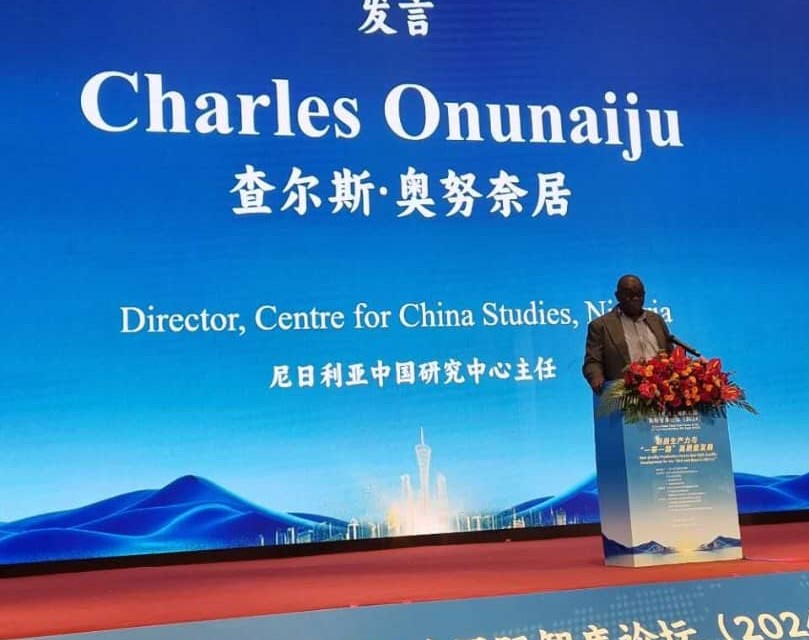
Being a paper presented at an international Seminar organized by the China Centre for Contemporary World Studies, Silk Road Think Tank Association International Department of the Communist Party of China (CPC) in Guangdong Province of the P.R.China on the 22nd of November, 2024 by Charles Okechukwu Onunaiju.
Following in the tradition of the epochal Third Plenary Session of the 11th Central Committee of the Communist Party of China, in 1978 in inaugurating Reform and Opening Up as the key in China’s modernization effort, both the 3rd Plenary Sessions of the 18th and the 20th Central committees in 2014 and 2024 respectively have reaffirmed deepening reforms and opening up comprehensively as the fundamental strategy and roadmap for advancing and elaborating modernization in China.
In the important Resolution of the Third Plenary Session of the 20th Central Committee of the CPC last July, it underscored the significance of Reform and Opening up, which it held to “have been crucial to the cause of the party and the people, enabling us to catch up with the times in great strides”. The “great strides” enabled by the “bold trajectories of Reforms and Opening up”, is not a mere political correctness or a rhetorical flourish, but a process imbued with an acute understanding of the existential hiccup of the so called “middle-income trap” a phenomenon commonly associated with emerging economies, and which is a situation where a country’s GDP per capita reaches a middle level of income but cannot develop further into a high-level income country, due to variety of reasons among the most prominent is the rise and vehemence of special and vested interests.
In these regards, the Chinese leadership has shown not only enormous courage to surmount and overcome the existential obstacle to steady advancement in modernization.
The resolution of the 20th Central Committee affirmed very boldly, this trajectory.
According to the resolution, “The Central Committee with Comrade Xi Jinping at its core has, with great historical initiative, tremendous political courage and a strong sense of mission, united and led the entire party, the military and Chinese people of all ethnic group in unshackling their thinking and breaking down the barriers erected by vested interests” and at the same time, “dared to brave uncharted waters, grapple with tough problems and navigate potential dangers and have worked resolutely to remove institutional obstacles in all areas”.
The path to unraveling China’s contemporary modernization trajectory start with understanding the perennial toil of the Communist Party of China in theoretical innovation, the clear fountain, without which practice would be rudderless. From the foundational scientific theory of Marxism, and its dynamic core of dialectical/historical materialism, the CPC has continuously explored its boundless and infinite expanse, finding and exploring a theoretical context for questions posed at any given time and circumstances in the endless historical trajectories.
The rigour of this inquiry is only compensated by the vigour of its outcome, and which comes with a promise of fresh historical initiative and momentum. The latest outcome in such endeavour of theoretical innovations, is the system and method of “Xi Jinping Thought on Socialism with Chinese Characteristics for the New Era”.
The CPC historical experience and its accumulated wisdom found its most robust and contemporary expression in the enigma of the General Secretary, Xi Jinping, the core of the unified Central Committee of the party. As an outstanding proletarian theoretician, his insight drawing from the fountain of the Party’s accumulated wisdom has not only resolved previously difficult and overwhelming issues, but provided enormous clarity on the issues, themes and prospects for advancing with courage and confidence on the path of modernization in the new era. While the utility of “Xi Jinping Thought on Socialism with Chinese Characteristics for a New Era” is well adapted to Chinese national condition, its overall impact in understanding the unique condition of the human kind and the application to the specific context of contemporary world development is both equally thought –provoking in seeking clarity to the issues of the times.
At the recent summit, of Chinese and African leaders in Beijing, under the auspices of the Forum on China-Africa Cooperation (FOCAC), General Secretary Xi Jinping, who is also the President of the People’s Republic of China with great insight affirmed unequivocally that “modernization is an inalienable right of all countries” and urged that “in promoting modernization”, we should not only follow the general rules but also in the light of our national realities”, and declared “the ultimate goal of modernization is the free and full development of human beings”. He asserted that “China and Africa’s joint pursuit of modernization will set off a wave of modernization in the Global South and open a new chapter in our drive for a community with a shared future.
Most of the world in awe of the dramatic change of fortune for China, previously derided as the “Sick man of Asia”, called the inspiring and dramatic shift in China’s national destiny, a miracle”. But it is certainly not. A China modernization is a deliberate choice borne out of the acute understanding of the country’s unique experience, history and national condition which has illuminated a path of development, that proceeded from the country’s existential realities.
It is simple to write about this trajectory, but the choice of it and the will and courage to persevere and endure through the path is not a walk in the Park and even more herculean than “doing embroidery”. China’s modernization not only exemplifies the power of vision and the strength of conviction but also the fortitude to persist.
Far from a jolly ride, even the decision and determination to persist on the path, rankled some international ideologically- bigoted sector, who has arrogated to themselves the sole and exclusive prerogative to define everyone’s path to modernization and development. Ideologically harassed, politically provoked, economically undermined, with desperate attempts to diplomatically isolate her, China weathered the storms to persist in the path of modernization that have not only delivered to its people unprecedented improvement in their fortune, but also elaborated and clarified the understanding that each nation and every people can leverage their unique experiences and find a path to modernizations that is not only suitable to their condition but to their needs.
The choices most times are easy to make but to stay on the path of the choices made are the real issues of the existential reckonings. Underwriting China’s choice is the leadership of the Communist Party of China. Choices made and the road traveled are not whimsical and happenstance but a deliberate concerted effort driven by the rigour and vigour of a leadership unfazed by hardship nor gratified by any sense of entitlement and priviledge.
The implications on a global scale for the success of China’s modernization is not so much about its achievements in physical transformation of its landscape and even the moderate prosperity of her people but more in the privations, struggles, diligence and forthrightness of its authors. To see the achievements of modern China without understanding the rigour of insights and the practical toil that saw it through and continues to oversee it, is to miss out in the fundamental lessons it offers, to those who seek to seize the initiative of their own national destines.
China modernization and its fruits have escalated to international public goods generating concrete inputs.
The Belt and Road Initiative or BRI, a framework of International Cooperation has in the more than ten years become a formidable and most subscribed international public good on offer, with its practical gains and fruits, spread across countries along its routes, without an undoubted impact across the universe. A study of the World bank titled “How Much Will the Belt and Road Initiative Reduce Trade Cost”, in 2018 concluded in the 43-page monograph that’s its “key finding is that the Belt and Road Initiative can substantially reduce shipment times and trade costs for BRI economies up to 3.2% and 2.8% respectively and for the world as a whole by up to 2.5% and 2.2 % respectively”.
At the 3rd Summit of Belt and Road forum held in Beijing in October, 2023, President Xi Jinping pointed out in his keynote remarks that “Belt and Rod Cooperation has progressed from “sketching the outlines” to “filling the details,” and blueprints have been turned into real projects”. He further noted that “over these 10 years, we have endeavoured to build a global network of connectivity consisting of economic corridors, international transportation routes and information highway as well as railways, roads, airports, ports, pipelines and power grids; covering the land, the ocean, the sky and the internet. This network has boosted the flow of goods, capital, technologies and human resources among countries involved and injected fresh vitality into the millennia-old Silk Road in the new era”.
The Silk Road, also known as the Friendship canal based up on the Silk trade between the West and the East. In the 2nd century BC, Emperor Wu of the Han dynasty twice sent Zhang Qian on a diplomatic mission to the Western lands; the road to the West was opened and brought more convenience to the contacts and communication between ancient China and Middle Asia than in previous times. The Silk Road in ancient times improved friendship among nationalities and promoted the development of human civilization. Large consignments of Chinese silk were transported to the West and other parts of the world including East Africa along this road, thus the name Silk Road. Other Chinese materials beside Silk, like metallic tools, cast irons and paper-making technologies were introduced to Europe via Middle Asia.
Xian, the capital city of Shaanxi province was the Eastern starting point of the Ancient Silk Road, which was not just a road, but an international melting pot of commercial and cultural activities, bringing products from one side of the world to the other, which became remarkable for cultural, intellectual, artistic, commercial and technological exchanges.
Today, China recreates and re-found the Silk Road, not only for facility connectivity, policy coordination, unimpeded trade, financial integration, people-to-people contact but as a framework for civilizational dialogue, joint efforts for global collective security and shared experience in development.
The “Silk Road Economic Belt” and the “21st Century Maritime Silk Road” proposed by President Xi Jinping more than a decade ago has grown into a global orchestra with many different voices rending to the beautiful harmony of a community of a shared future for humanity.
Africa has been an outstanding region, where the Belt and Road framework have seamlessly synergized various national initiatives of the various states to produce the most remarkable connectivity within and across countries in the region. The region’s historic deficit of infrastructure connectivity, bequeathed by European rapacious colonialism, is being gradually narrowed within the framework of the Belt and Road partnership and this is why Africa is the region, with the largest number of countries in the Belt and Road international partnership.
China modernization drive and the initiative of the Belt and Road are open process of experience-sharing and partnership that is at the heart of the 21st Century, shaping its trajectories, delivering both vital lessons and benefits in a world undergoing changes only seen once in a century.
Thank you for listening.

0 Comments