China is ready to work with African countries to deliver tangible outcomes from the 10 partnership action plans proposed at the Summit of the Forum on China-Africa Cooperation (FOCAC) held in Beijing last year, ensuring that both sides can advance faster, more steadily, and further on their path toward modernization, Chinese Foreign Minister Wang Yi said at the conclusion of his successful 4-Nation tour of Africa. Wang, also a member of the Political Bureau of the Communist Party of China (CPC) Central Committee, made the remarks during his visits to Namibia, the Republic of the Congo, Chad, and Nigeria. He said during his visits to the four countries, he had in-depth exchanges with leaders of the countries regarding the implementation of the FOCAC Beijing Summit outcomes and reached a broad consensus.
President of the Republic of the Congo Denis Sassou Nguesso and other African leaders said that the 10 partnership action plans comprehensively address every aspect of China-Africa cooperation and tackle Africa’s pressing challenges, fully align with Africa’s needs, and will provide substantial support for the continent’s development and revitalization, Wang said. Throughout the visits, Wang said, it was evident that African countries attach great importance to implementing the summit outcomes and deepening China-Africa cooperation.
The Partnership Action for Mutual Learning among Civilizations ranks first among the 10 partnership action plans, reflecting its profound significance in today’s world, Wang said. Both China and Africa have long histories and rich civilizations, and both are actively committed to national development and revitalization, he said. Under the strong leadership of the CPC, China has charted a successful development path suited to its national conditions, achieving significant progress in its modernization drive, Wang said, adding that these achievements offer valuable insights and new opportunities for African nations seeking to accelerate their development and revitalization. China and African countries have decided to strengthen exchanges and mutual learning between their civilizations and share governance experiences, laying a stronger and broader political and social foundation for China-Africa cooperation, Wang said.
Regarding his visit to Africa, Wang said the tradition of making Africa the first overseas destination for China’s foreign minister each new year is a hallmark of Chinese diplomacy, which has been upheld consistently for 35 years, setting a unique precedent in international relations. This tradition demonstrates to the world that regardless of changes in the international or regional landscape, China’s commitment to Africa remains unwavering, he said. China will always be the most trustworthy friend of its African brothers and sisters, the most reliable partner in their pursuit of development and revitalization, and the strongest supporter of Africa on the international stage, Wang said, stressing that Africa will always remain a priority in China’s overall diplomatic strategy.
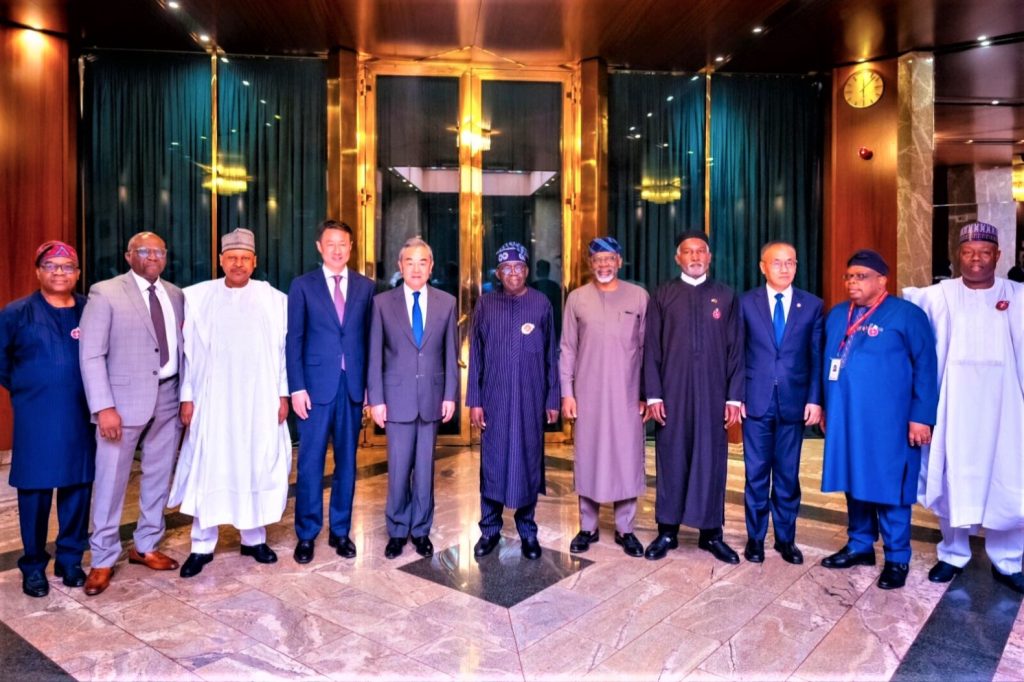
In Nigeria, the Government says it is deepening its security partnership with the People’s Republic of China for local arms production and military training. It says this forms part of its broader strategy to tackle terrorism and other forms of insecurity within and outside its borders. Nigeria’s Minister of Foreign Affairs, Yusuf Tuggar, stated this when he briefed State House correspondents after President Bola Tinubu received China’s Foreign Minister, Wang Yi, at the Aso Rock Villa, Abuja.
Tuggar stated that bolstering cooperation with key partners like China would help Nigeria and its neighbours respond to shared threats more efficiently. “We want to work with countries like China in domesticating production of military equipment, both kinetic and non-kinetic. “We’re looking for this, so, we don’t have to go out looking to procure with delays and many rules and regulations. We need to be able to produce locally,” he said.
He also dispelled any notions that Nigeria would rely on private military companies to tackle its security challenges. He also underscored Nigeria’s role as a leader in West Africa’s security, particularly in the Sahel. “Let us work together towards solving our problems by ourselves. Let us shun this idea of allowing others to solve our problems for us. So, private military companies, as far as we are concerned, don’t matter whether they’re from north, south, east, or west. We don’t think it is going to provide the panacea,” Tuggar said. “But when you (China) work with us, we can lead others in solving the problem. Nigeria is a very responsible country working with the constitution, so we’ve never had any expansionist tendencies. “This is why others repose so much confidence in us and our leadership. And we will continue to work with countries such as China to address these challenges.” Nigeria and China also have rejected external interference in Africa’s security affairs, reaffirming their commitment to African-led solutions for regional peace and stability.
China’s Foreign Minister, Wang Yi, emphasised his country’s opposition to foreign involvement in Africa’s internal matters, stressing the importance of African nations leading their own peacekeeping and counterterrorism efforts. Wang pledged Beijing’s full support for initiatives aimed at enhancing the continent’s security, including a CN¥1bn military assistance package. This also includes training 6,000 military personnel and 1,000 police and law enforcement officers for various African countries and supporting the African Standby Force and rapid response forces.
“China will firmly support Africa in strengthening peace and security capacity building. We will work with Africa to establish a partnership for implementing the Global Security Initiative, or GSI, and make it a fine example of GSI cooperation. “China will also continue to support the building of the African standby force and the rapid response forces and support African countries in carrying out counter-terrorism peacekeeping operations. China will firmly support Africa in safeguarding its legitimate rights and interests, practising true multilateralism and not letting power politics and bullyism (sic) find their place in Africa,” Wang affirmed. He also affirmed that his country would consider Nigeria’s request to expand the bilateral currency swap agreement, following President Tinubu’s appeal for the Chinese government to increase the $2bn currency swap between Nigeria and China to enhance trade between the two countries.
The Nigerian leader also called for an upward review of the $50bn aid package for Africa, which China’s President Xi Jinping announced last year. Initially inked in 2018 between the People’s Bank of China and the Central Bank of Nigeria, the swap was valued at CN¥15bn, equivalent to about N720bn (roughly US$2.5bn at the time). By reducing reliance on the US dollar, the agreement was meant to help stabilise Nigeria’s foreign reserves while spurring trade and investments between the two nations. President Tinubu said increasing the level of currency swaps would speed up the infrastructural development in Nigeria and deepen the strategic bilateral relations. “We still demand more in the area of currency swap. The level you have approved as a government for Nigeria is inadequate, considering our programme. If you can increase that, it will be well appreciated. Our bond should grow stronger and become unbreakable,” the President said.
Regarding the $50bn pledged by the Chinese government to support Africa, Tinubu noted that the continent’s infrastructural needs would require more commitment, urging a review of the amount to reflect the continent’s reality. On his part, Wang said Beijing would support an African country in the UN Security Council, adding that “it was a historical injustice by the world that should be corrected.”
The foreign minister said China would welcome Nigeria’s membership of BRICS and participation in the global development mechanism. He said China fully supported Dr Ngozi Okonjo-Iweala, the Director General of the World Trade Organisation, for a second term in office. Wang highlighted Nigeria’s influential role in Africa, particularly as the chair of ECOWAS and a key player in maintaining peace and stability in West Africa and the Sahel region.
Therefore, “China supports Nigeria in rallying countries in the region to achieve strength through unity, to build synergy through reconciliation, and to promote security through cooperation, in order to achieve peace and stability in the region, and China, would like to make its contribution to the best of its ability to that end,” Wang said. He reaffirmed the momentum in bilateral financial ties, inviting Nigeria to explore issuing Panda bonds in China’s markets while expressing confidence in Nigeria’s economic stability. Panda bonds are renminbi-denominated bonds issued by foreign entities in China’s domestic bond market. By issuing these bonds, foreign governments, financial institutions or corporations can raise capital in mainland China, giving them direct access to China’s liquidity and investor base.
For the issuing entity, Panda bonds can help diversify funding sources and hedge against exchange rate risks. At the same time, Chinese investors benefit from broader investment opportunities in RMB without dealing with cross-border currency conversions. Wang reasoned that by tapping into these bonds, Nigeria stood to gain an additional stream of revenue that would support key infrastructure endeavours such as railway modernisation, with safety ensured through targeted financial backing. He noted, “The currency swap agreement shows how well we have carried out our financial cooperation and sustained its momentum. Regarding Nigeria’s wish to increase the line of the currency swap, we will favourably study and consider the issue. “Our cooperation is going well in many ways in terms of finance. For instance, we welcome the Panda bonds to be issued.” We welcome Nigeria to issue Panda bonds in China because we have complete confidence in Nigeria’s credibility. “By issuing Panda bonds, Nigeria will gain good revenue and safety is guaranteed through financial support; we are working to contribute to Nigeria’s infrastructure development, particularly the railway.” Furthermore, he lauded Chinese banks for their recent financial contribution to Phase III of Nigeria’s railway modernisation project, noting it as a tangible example of ongoing cooperation.
0 Comments