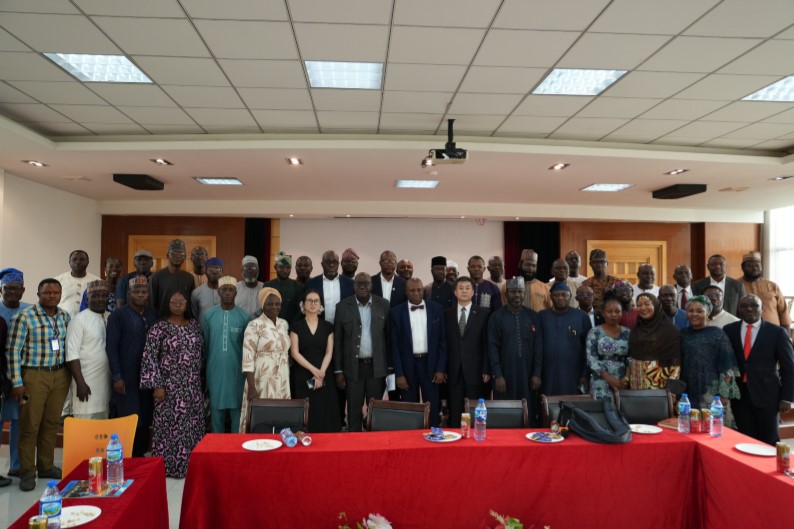
Nigeria’s scholarly community from top Think Tanks, Research institutes, Universities, Diplomatic missions and the media have stressed the importance of knowledge sharing and policy dialogue in strengthening cooperation between Nigeria and China, describing mutual learning as a vital component of the expanding bilateral relationship. The call was made during a roundtable dialogue on “The Governance of China and Knowledge Sharing in Nigeria-China Cooperation: Implication for Mutual Learning,” organized by the Centre for China Studies and held in Abuja, Nigeria’s capital.
The forum brought together academics, researchers and foreign policy analysts to examine governance practices and development experiences that could support stronger collaboration between the two countries.
Addressing participants, Counselor of the Chinese Embassy in Nigeria, Mr. Wang Jun in a goodwill message said China’s governance experience offers useful insights into addressing contemporary development challenges. He noted that the series, “The Governance of China,” which compiles speeches and writings of Chinese President Xi Jinping, who is also the General Secretary of the Communist Party of China (CPC), provides a comprehensive understanding of China’s policy direction, development philosophy and governance approach.
According to him, the publication highlights practical strategies that have contributed to China’s socio-economic transformation, particularly in poverty reduction, environmental sustainability and long-term development planning. He stated that, “by gathering to study Xi Jinping: The Governance of China, the dialogue participants would gain a deeper understanding of the secrets behind China’s governance success and explore how these ideas can be adapted to Nigeria’s and Africa’s realities — turning them into practical wisdom for enhancing governance capacity and promoting socioeconomic development”.
Wang observed that China’s success in lifting hundreds of millions of people out of poverty demonstrates the effectiveness of targeted development policies and strategic governance. He added that China remains committed to sharing its development experience with Nigeria and African countries while respecting their unique political, economic and social realities. According to him, “the concept of targeted poverty alleviation outlined in the books emphasizes precise, tailored measures for each village, household, and individual. China successfully lifted nearly 800 million rural residents out of poverty. This philosophy and methodology holds significant practical value for Nigeria and other African countries in their efforts to eradicate poverty and promote inclusive development”.
He stressed that sustained dialogue among scholars, policymakers and development practitioners would promote greater understanding and contribute to efforts aimed at improving governance and economic growth across the continent.
In his presentation, Director of the Centre for China Studies, Charles Onunaiju, said Nigeria-China relations have witnessed significant growth since both countries elevated their ties to a Comprehensive Strategic Partnership following President Bola Tinubu’s visit to China and participation in the 2024 Forum on China-Africa Cooperation (FOCAC) Summit. He noted that cooperation between the two nations has expanded across several sectors, including infrastructure development, agriculture, industrialisation, trade, investment, education and cultural exchange.
Onunaiju argued that beyond economic cooperation, intellectual engagement and policy-oriented discussions should become an important pillar of bilateral relations. He maintained that deeper research collaborations and exchanges of ideas would help unlock new opportunities and ensure that the benefits of Nigeria-China cooperation reach broader segments of society. According to him, “we are opening a new path to Nigeria-China cooperation because despite the several milestones it has reached, its opportunities need to be further clarified and to bring it to the mainstream of the social fabric of the two nation, research and extensive intellectual discourse would be considerably required”.
Also speaking, Director of the Centre for Contemporary China-Africa Research, Prof. Sheriff Ghali Ibrahim, examined key themes contained in the five volumes of “The Governance of China” and related publications. He said the books provide insight into China’s policy priorities, including poverty eradication, rule of law, ecological sustainability, national security, modernization and international cooperation.
According to him, one of the major lessons from China’s development trajectory is the importance of designing policies that reflect a country’s specific realities while maintaining consistency in long-term national planning. Ghali identified initiatives such as the Belt and Road Initiative, environmental conservation programmes and policies aimed at promoting shared prosperity as examples of experiences from which developing nations could draw valuable lessons. He further highlighted the growing scope of Nigeria-China collaboration in infrastructure, energy, media, technology and digital development, describing the relationship as increasingly strategic.
Participants which included representatives of Nigeria’s top government Think Tank – Nigeria Institute for Policy and Strategic Studies (NIPSS), Nigeria Institute for International Affair (NIIA) among others at the dialogue agreed that continued engagement between academic institutions, government agencies and policy experts from both countries would help deepen mutual understanding and support the implementation of development-focused partnerships. They described knowledge exchange as an essential tool for sustaining the momentum of Nigeria-China relations and advancing shared development objectives.
0 Comments