“At present, changes unseen in a century are accelerating across the world. Yet, no matter how the international landscape or the situation in the Taiwan strait may evolve, the overarching direction of development and progress will not change, the prevailing trend toward the great rejuvenation of the Chinese nation will not change and the great tide of compatriots on both sides of strait becoming closer, more connected and coming together will not change. This is the verdict of history” – Xi Jinping, General Secretary Communist Party of China, (CPC).
“The laws and regulations on both sides of the strait each stipulate that relations between the two sides are not State-to-State relations. In 1992, the authorized bodies of both sides reached a consensus that each side would express verbally its adherence to the One-China principle while seeking common ground and setting aside differences. This became the political foundation of cross-strait consultation and communication mechanisms. Historical facts cannot be denied. On this basis, consultation mechanism should be restored to build up a positive cycle of goodwill” – Cheng Li-Wun, chairwoman of KMT or Nationalist Party, majority party in Taiwan’s regional parliament.
The two quotes were taken from statements of a recent meeting of the two Chinese main legacy political parties in Beijing last month. It underscores the main trends in China’s domestic political arena, featuring increasing convergence of both popular sentiments and patriotic fevours across the strait to uphold their common homeland. As a result of their own history, both Chinese people living across the strait of the mainland and the Island have been exposed to different social systems and the “One country, two systems” is designed to acknowledge the reality of the differing exposures while reinforcing the shared roots of their common homeland. The “One China Principle” has been built around the unassailable pillars of history and existential reality. And in the global context, the consensus established around “One China” principle with the historic United Nations resolution 2758 titled “Restoration of the lawful rights of the People’s Republic of China in the United Nations” was definitive, unequivocal and unambiguous.
The iconic resolution states “Recognizing that the representatives of the government of the People’s Republic of China are the only lawful representatives of China to the United Nations…and recognize the representatives of its government as the legitimate of China to the United Nations”. Global policy convergence and diplomatic consensus around this historic and pivotal resolution is illustrated by the fact that 186 countries out of the 198 members of the United Nations have official position of “One China” policy with only 12as laggards. In Africa, it is only the 1.3 million Eswatini, the former Swaziland that is yet to come round to the consensus of 53 countries and regional organizations in Africa on their unambiguous “One China Policy”.
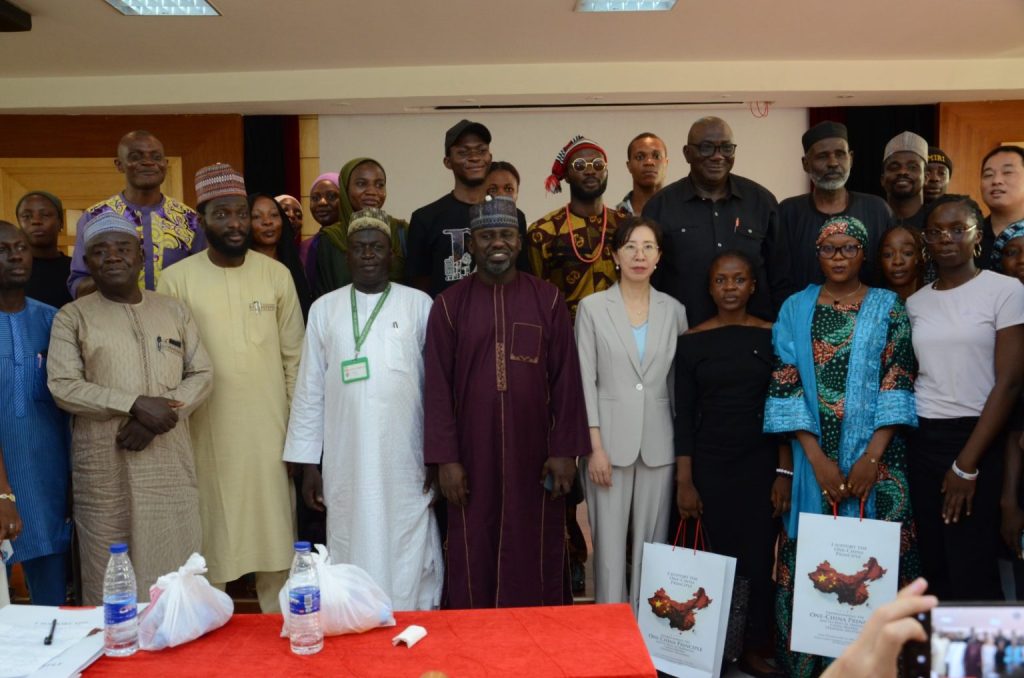
While these are unambiguous and unmistakable trends, both reflecting historical and contemporary realities, that upholds and reinforces “One China Principle”, the question arises as to who beats the drum of Taiwan “Independence” and “Seperatism”. The local figure-head of the aberration of Taiwan ‘Seperatism’ is Mr. Lai Ching-te and his circle in the Democratic People’s Party (DPP). Increasingly isolated, and gradually cut off from the mainstream of even the local political sentiments, in the Island, have become very desperate.
But more importantly, China does not canvass “strategic autonomy,” the favourite sound bite of France president in international relations but practices independent policy that is not viewed favourably in the West and especially in Washington. Historically playing the ‘Taiwan card’ to undermine, contain and constrain China is Washington’s and Brussels’ favorite games. Despite the joint three communiqués of unambiguous One-China Principle as the basis for the establishment of China-U.S bilateral relations and diplomatic recognitions, Washington indulges in what it gleefully calls “strategic ambiguity” to undermine her own credibility by selling weapons and canvassing militarization of the strait in the subtle incentives to the region’s separatist clique. Thankfully, Nigeria and the rest of Africa do not play the ‘Taiwan card’ and were completely unequivocal that there is only One China in the world and Taiwan is an inalienable part of China.
Finally, in my understanding, Beijing does not beg for anyone to recognize or acknowledge ‘One China Principle’. It is reality rooted in the core fabric of China’s sovereignty and territorial integrity and any attempt to violate it would incur such an unmistakable cost that is actually unreasonable to try. Foreign minister Wang Yi, has actually made the point that such attempt would be the equivalent of “lifting a stone only to drop it on one’s own feet”.
However, as a responsible major country, Beijing takes seriously to continuously clarify the serious issues around her core and non-negotiable national interest, the “One China Principle” and as a long term observer of China and the world, what I have done here is to add my modest perspective to those clarity efforts.
Charles Onunaiju,
Center for China Studies (CCS), Abuja, Nigeria.

0 Comments