Host: Mr. Charles Onunaiju (Director, Centre for China Studies, Abuja)
Introduction
The conference commenced with opening remarks by Mr. Charles Onunaiju, Director of the Centre for China Studies, who warmly welcomed and introduced all attendees which comprise:
- Prof. Xu Wei – Deputy Director, Institute of African Studies, Zhejiang Normal University.
- Associate Professor Ehizuelen Michael Mitchell Omoruyi – Executive Director, Centre for Nigerian Studies, Institute of African Studies, Zhejiang Normal University.
- Dr. Wang Yan – Chinese Director, Centre for Nigerian Studies, Institute of African Studies, Zhejiang Normal University.
- Dr. Chen Biao – Researcher, Institute of African Studies, Zhejiang Normal University.
- Prof. Joseph Golwa – Senior Fellow at the Centre for China Studies.
- Lanen Law Kuma – Fellow, Centre for China Studies.
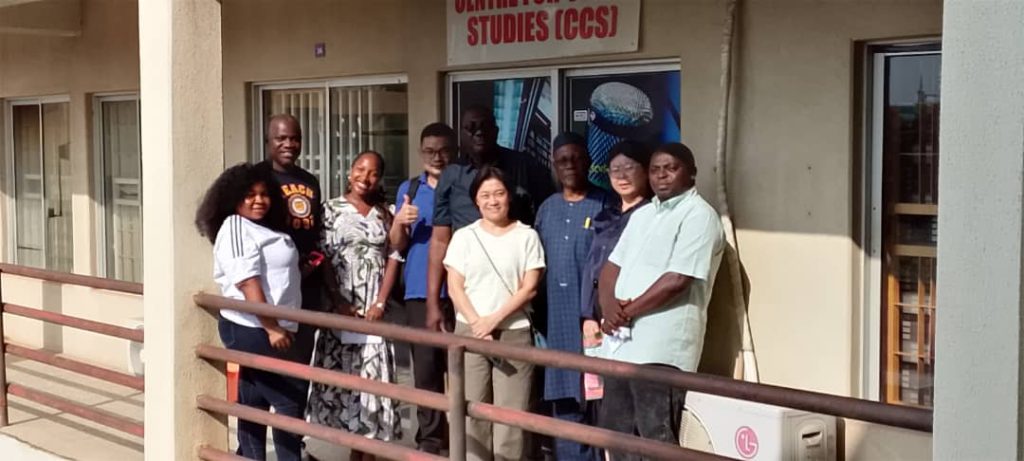
The Meeting Overview
The primary objective of the meeting was to deliberate on potential areas of collaboration and capacity building between the Centre for China Studies (CCS) and Institute of African Studies, Zhejiang Normal University. In the meeting, staging of workshops and joint publications to deepen academic and cultural engagement was proposed.
Details
After introductions made by the Director of the Centre for China Studies (Mr. Charles Onunaiju), Prof. Xu Wei – Deputy Director of the Institute of African Studies, Zhejiang Normal University, expressed her excitement at visiting Nigeria for the first time and mentioned her anticipation for the upcoming Abuja Forum, an annual cooperation platform between the Institute of African Studies and Chinese institutions. She noted that this collaboration has yielded talent exchange programs, including Nigerian students pursuing postgraduate studies in China and Chinese students visiting Nigerian universities, particularly the University of Ibadan.
In a like manner, Mr. Charles Onunaiju reiterated the Centre’s (Centre for China Studies) commitment to fostering long-term China–Africa cooperation built on a knowledge bridge and mutual intellectual exchange. He emphasized the importance of revisiting traditional frameworks influenced by Western paradigms and encouraged the integration of think tanks to promote locally grounded research and policy insights.
He further stressed the need to cultivate young scholars and professionals to sustain these
collaborations, encouraging the dislodgment of outdated concepts imposed by external
narratives. According to him, platforms such as the Abuja Forum and Ibadan Forum play vital
roles in strengthening these academic and intellectual exchanges.
Prof. Joseph Golwa, Senior Fellow at the Centre for China Studies, endorsed the points raised
by Mr. Charles Onunaiju (Director of the Centre for China Studies), highlighting education and
health as priority areas of focus. He contributed that knowledge-driven governance should
remain central to China—Africa cooperation. Prof. Golwa also encouraged sustaining existing
Think Tanks to explore the key provisions of the Memorandum of Understanding (MOU) and
implement them in mutually beneficial ways.
Also, Dr. Wang Yan, Chinese Director of the Centre for Nigerian Studies, Institute of African
Studies, Zhejiang Normal University, emphasized the essence of shared knowledge in China—
Africa cooperation. She underscored the value of leveraging China’s development experience
to support African progress.
Likewise, Mr. Charles Onunaiju, Director of the Centre for China Studies, further emphasized
the importance of aligning African institutional structures with indigenous realities. He noted
that China’s rapid development stemmed from its deep understanding of its own societal
context, while Africa’s underdevelopment often results from a disconnect between institutional
frameworks and existential realities. He concluded that once Africa realigns its systems with
its own realities, it can potentially surpass China’s developmental trajectory.
Dr. Wang Yan equally addressed issues surrounding the One China Principle and Taiwan. In
response, Mr. Charles Onunaiju proposed the creation of an academic journal that will focus
on the Taiwan question, suggesting it could serve as a medium to clarify and reinforce the One
China Principle, noting its potential to provide scholarly clarity and sustained dialogue on the
issue.
Assistant Prof. E. M. M. Omoruyi, Executive Director of the Centre for Nigerian Studies,
Institute of African Studies, Zhejiang Normal University, proposed organizing a workshop or
seminar to strengthen CCS’s visibility and output. He also supported the proposed joint
publication with the Chinese Institute, an academic journal featuring key themes and outcomes
from collaborative conferences to translate MOU commitments into concrete actions. He
agreed to draft a concept paper on this agreement and submit to the Centre for China Studies
for approval.
Building on this, Prof. Joseph Golwa, Senior Fellow at the Centre for China Studies, proposed
“Journal of the Centre for China—Africa Studies” as the title for the publication. This
publication could be published biannually and later expanded to a quarterly or bimonthly issue.
He also mentioned that the publication will accommodate diverse international perspectives,
including submissions from Western scholars with open views on China—Africa relations.
Conclusion
The conference concluded with mutual agreement on the importance of deepening cooperation
through sustained dialogue, academic exchange, and knowledge sharing. All participants
reaffirmed their commitment to strengthening the intellectual foundation of China—Africa
relations through joint research, publications, and youth engagement. The meeting ended with
a group photograph, symbolizing the shared commitment to building stronger academic and
cultural bridges between Nigeria and China.
0 Comments